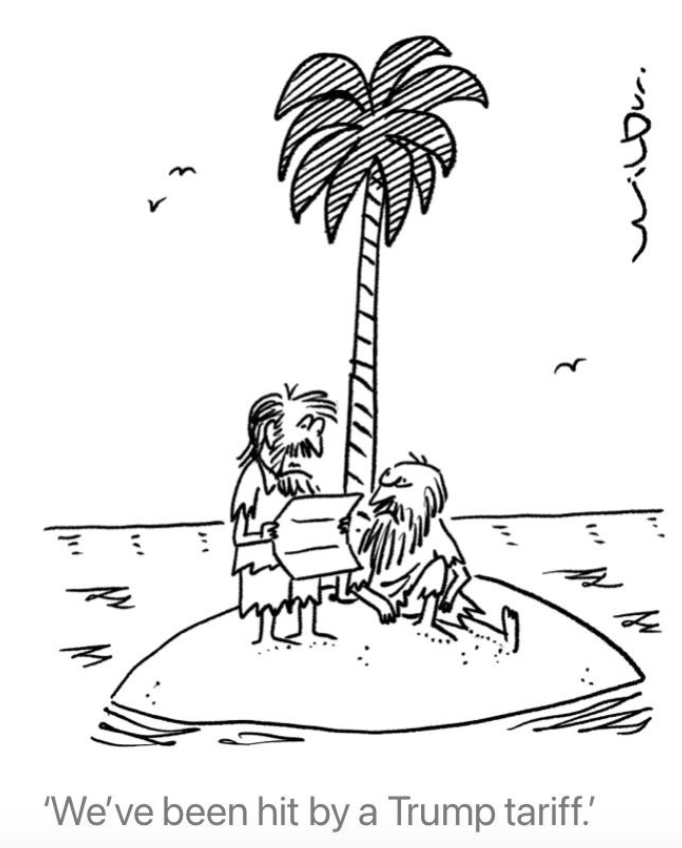
Recent events have got me wondering: Am I the idiot here?
Is there a scenario where Trump is immaculately out manoeuvring all the global players and making all of us who are critical of his actions look stupid? I certainly hope not but his playbook is so outlandish and seemingly irrational that it is getting suspicious. Perhaps he wants us to think he’s incompetent just to play his TRUMP card at the last minute (pun absolutely intended!!)?
Bill Ackman, billionaire hedge fund manager, said that Trump’s 90-day tariff break was “Textbook. Art of the deal” and Stephen Miller, deputy chief of staff for policy, claimed we “have been watching the greatest economic master strategy from an American President in history”.
Textbook!!! HA!
From someone who has only just recently stopped reading textbooks, this certainly doesn’t quite fit the bill.
So what caused this tariff U-turn from Trump? I doubt he was trying to see if they were working by turning them on and off again but rather is there finally an adult in the room in the White House? Stocks reacted badly to “Liberation Day” but it was really on Friday when investors were no longer rushing to buy dollar assets such as US Treasuries that proved to be a turning point. This evokes my earlier article where I questioned the “safe haven” status of US assets and that holding the dollar can prove burdensome. The big news in the past week has been that it wasn’t so much the stock market that catalysed the U-turn but in fact the bond markets which leaves massive implications for US borrowing costs. A lightbulb moment or, perhaps more accurately, a kick up the backside moment for the Trump administration.
If the “art of the deal” or the goal of the “greatest economic master strategy” is to throw into doubt the safety of US assets, to diminish the relationship with allies, and send stock markets plummeting off of a storm of uncertainty then I tip my hat. The most important thing, however, is that it is throwing into question the reliability of the US as a trading partner, wartime ally, and friend. This will deter nations from doing business with America and force them to look elsewhere for safer, more reliable relationships. It also opens the door for Europe and South America to create closer ties with America’s biggest economic foe: China. To exacerbate things for the US, their ability to muscle allies into falling in line with their foreign policy weakens since this administration has virtually offended every nation on earth other than Russia as well as the implementation of a blanket 10 per cent tariff.
This leads me to another crucial point and that is of unintended consequences which may not have been accounted for in this so-called master negotiation. Such unintended consequences involve businesses not doing what Trump expected them to do in the face of high tariffs. Such an example is that Jaguar Land Rover announced a month long pause of shipments to the US rather than announcing to manufacture in the US. A rather interesting one involves BYD, the Chinese car company. Because BYD has virtually no footprint in the US and predominantly does business domestically and South America, they are essentially unscathed in all this drama and it has given them the advantage over Tesla. Ever since Musk’s involvement in the US government and other governments for that matter, Tesla sales have dropped in the first quarter of 2025 and leaves them especially vulnerable to tariffs since a large number of cars are still made in the US.
There is a flawed fundamental assumption that rests in this textbook art of the deal. It is that the US holds all the cards. Sure it has a pretty good hand but it can’t keep going all in with the chips (speaking of chips, do you know how skilled you have to be to declare bankruptcy while owning a casino!?!). Some of this is slowly being unravelled in Trump’s camp as he offered exemptions to smartphones and consumer electronics imported from China to avoid the 125 per cent tariff.
Recent events have highlighted the importance of trust and reliability. Lesotho, a country “nobody has ever heard of” according to Trump, was hit by a 50 per cent tariff because this country apparently takes huge advantage of the US. Lesotho is the biggest African garments exporter to the US and actually a success story from the African Growth and Opportunity Act (Agoa) essentially offering tariff-free trade with Africa. Even this small country is looking to diversify away from trading such large volumes with the US and looking at its African neighbours. This reminds me of the supply chain diversification that happened during the pandemic. Businesses realised that pre-covid supply chains could not handle a shock such as a pandemic because its manufacturing was so concentrated in China. As a result, companies like Apple “de-risked” from China by making a fairly large proportion of products in India. Could we see more and more nations re-evaluating their balance of payments and start diversifying trade away from the US. All part of the master plan I suppose.
The way I like to look at it is this.
Let’s say you were sitting in the Oval office and you’re Trump. Let’s say you have the same goals for America. To put an end to everyone taking advantage of you, to bring back manufacturing to the US and to become more competitive in exports. What would you do to achieve this? Or, what would you NOT do to achieve this? I think the playbook for what you wouldn’t do looks awfully similar to what is currently happening.
If there are some serious acts of genius going around can someone please fill me in?
It seems like the administration is making it up as they go along but most crucially, the chopping and changing is putting off trading partners, businesses and investors. Businesses value certainty over almost anything. This way they can plan ahead and strategise on a known playing field but Trump is not giving anybody that peace of mind. Even if we are witnessing a masterclass, the damage has already been done. What’s that saying? You can’t put the shit back in the donkey.